How Do You Avoid Seasickness On A Green Island Cruise?
A practical, medication-free guide to avoiding seasickness on the 45 minute Cairns to Green Island crossing: which boat rides smoothest, where to sit, and what to eat beforehand.
How Do You Avoid Seasickness On A Green Island Cruise?
How Do You Avoid Seasickness On A Green Island Cruise?
You avoid seasickness on a Green Island cruise by choosing a fast catamaran rather than a smaller sailing boat, sitting in the middle of the vessel near the centre of motion, fixing your eyes on a steady point on the horizon, and eating a light meal a couple of hours before departure. If your stomach is genuinely sensitive, book a half day option; the crossing runs about 45 minutes each way.
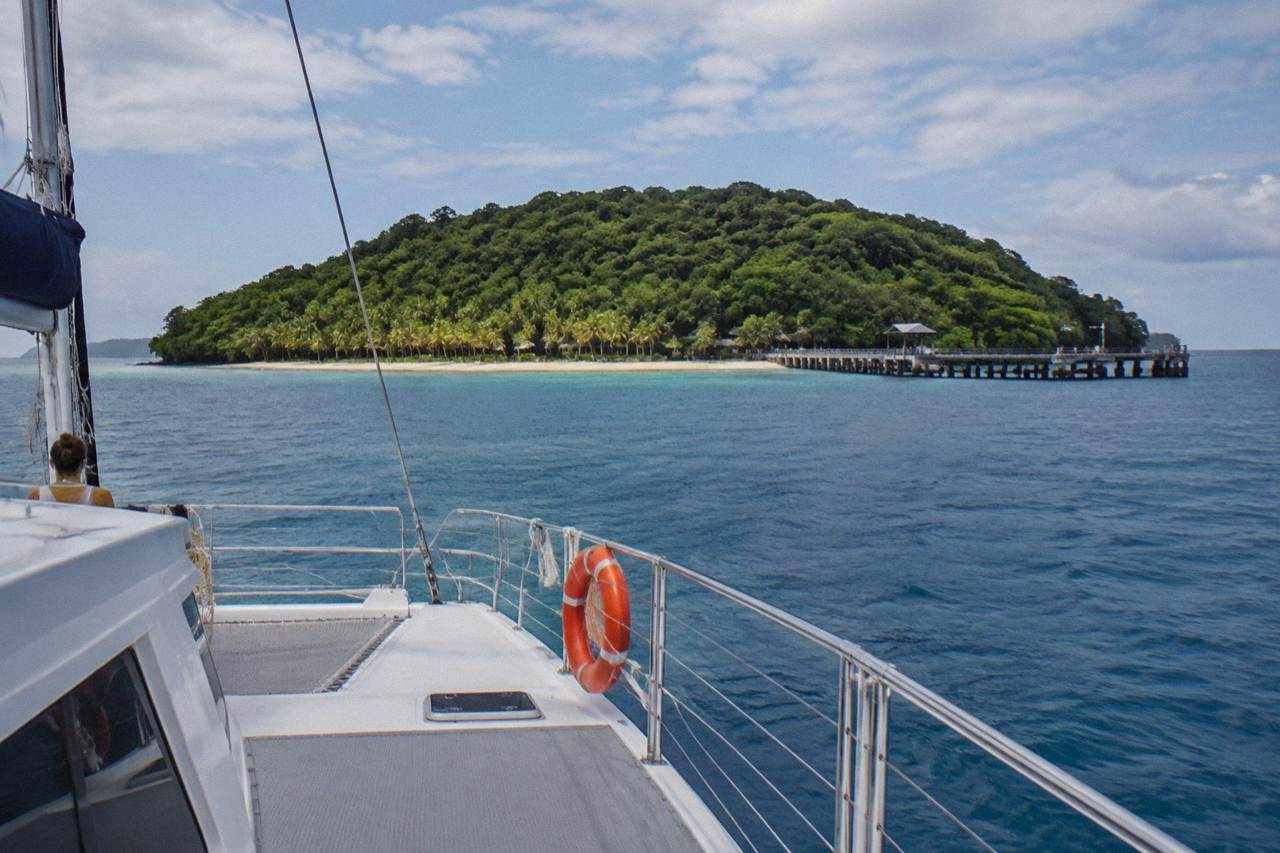
The honest starting point is that most people do not get seasick on this route at all. Green Island sits 27 km offshore from Cairns, and every scheduled tour out there, the Great Adventures fast catamaran, the Big Cat vessels, and the Ocean Free schooner, covers the distance in roughly 45 minutes on the standard crossing. That is a short exposure. The people who struggle are usually those who are genuinely prone to motion sickness, who pick a day with fresh wind against the tide, or who make the classic mistakes: a heavy fried breakfast, a night of no sleep, and a seat at the stern staring into the cabin.
This guide sticks to what can be said without a medical licence. It covers how the crossing behaves, the real differences between the boats that serve the island, where to sit on each of them, what and when to eat, and how the season and the weather change the equation. It deliberately avoids medication advice: if you want tablets, patches or anything medicinal, that is a conversation with a pharmacist or your doctor, not a travel website.
The three listings most worth comparing for a nervous sailor are the ones below, because they represent the two stable catamaran products and the one genuine sailing alternative on this route.
How Rough Is The Cairns To Green Island Crossing?
The Cairns to Green Island crossing takes about 45 minutes each way on all scheduled services, across open but sheltered inshore water. Great Adventures states the crossing time on its own timetable page, and Big Cat quotes the same figure. Conditions vary with wind and tide: flat and glassy on a calm dry season morning, choppy and bouncy when a south easterly blows against the run, and occasionally cancelled outright when a tropical system is in the region.
The Great Adventures timetable gives Cairns departures at 8:30am and 10:30am and island returns at 2:30pm and 4:30pm, with boarding 30 minutes before departure and check in at the Great Adventures counter inside the Reef Fleet Terminal at 1 Spence Street. Big Cat runs its full day departures at 9am and 11am with a return around 5pm, and half day sailings in a morning and an afternoon block, checking passengers in directly at its vessels at Marlin Wharf rather than inside the terminal. Both operators use the same stretch of water: out of Trinity Inlet, across the shallow inshore patch inside the reef line, then the final approach to the island jetty.
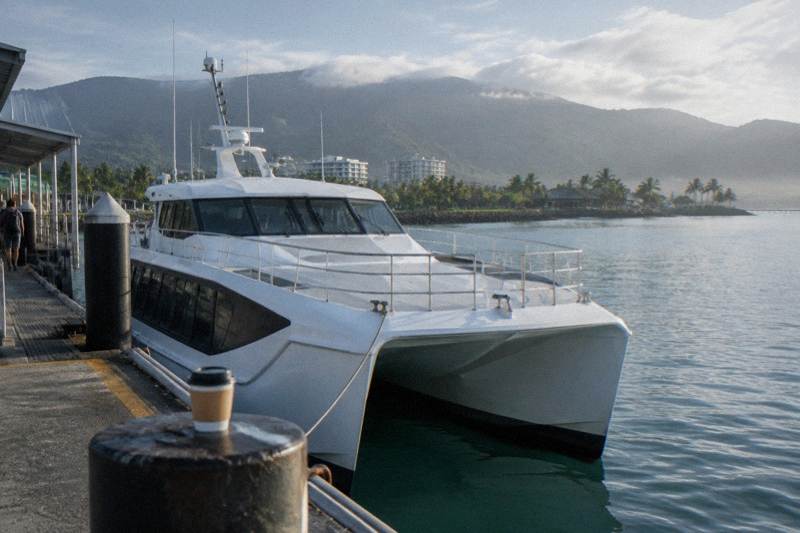
What makes this crossing friendly to sensitive stomachs is the geometry. A catamaran has two hulls and a wide beam, so it does not roll the way a single hulled boat does. The trade off is a quicker, snappier motion in a cross sea, a rapid up and down rather than a slow sway. Different people react differently to those two motions, which is why boat choice matters more than most guides admit. The Bureau of Meteorology's cyclone season page is worth a look if you are travelling between 1 November and 30 April, the official Australian tropical cyclone window, because crossings in the lead up to a system can be lumpier than any calendar month suggests.
A practical note on timing: the morning departures tend to catch the calmest water of the day in the tropics, before the afternoon sea breeze fills in. The 8:30am Great Adventures sailing and the 9am Big Cat full day both exploit that window. If you are prone to motion sickness and you have the choice, take the earliest boat of the day and treat the afternoon return as the necessary evil. The listing for the Great Adventures cruise, the most reviewed product on this route at 4.4 from 1,933 reviews with fares from A$112 per person, includes free cancellation, so a forecast that turns ugly the day before does not trap you.
Which Boat Gives The Smoothest Ride, Catamaran Or Schooner?
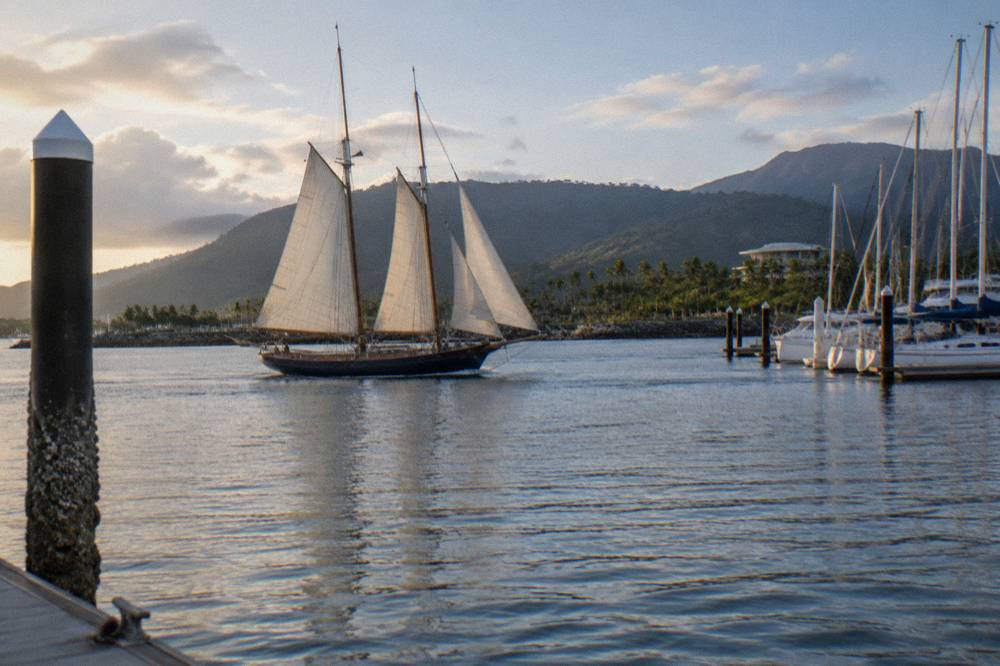
The catamarans give the smoothest ride to Green Island for most passengers: both the Great Adventures fast catamaran and the Big Cat vessels are wide, air conditioned and stabilised by their twin hulls. The Ocean Free schooner is a genuine sailing experience, 4.9 from 682 reviews, but it is smaller, slower to the island and moves more in the same sea, so it is the wrong choice for a genuinely sensitive stomach.
This is where the Green Island tours compared here do the deciding for you. In practice, three kinds of boat run this route, and the differences are not cosmetic.
| Boat | Operator | Type | Crossing feel | Rating and reviews | From price |
|---|---|---|---|---|---|
| Great Adventures catamaran | Great Adventures (Quicksilver Group) | Large fast catamaran, air conditioned cabin | Widest, steadiest platform; quick but flat motion | 4.4 from 1,933 reviews | A$112 pp |
| Big Cat and Reef Rocket | Big Cat Green Island Reef Cruises | Catamaran, air conditioned | Similar twin hull stability; full day or half day blocks | 4.5 from 1,727 reviews | A$110 pp |
| Ocean Free schooner | Cairns Premier Reef & Island Tours | Small group sailing schooner | More motion, slower passage, heeling under sail | 4.9 from 682 reviews | A$289 pp |
The Ocean Free deserves its rating; a 4.9 across 682 reviews is exceptional, and the listing includes lunch, morning and afternoon tea, a complimentary glass of wine on the return sail and full snorkel gear with in-water crew assistance. But honesty about seasickness means naming the trade: a schooner that actually sails moves through the water rather than over it, and that means heel, roll and a longer time on the sea. For a confident sailor it is the best day on this list. For someone who has been sick on a ferry before, the big catamaran is the rational pick, and the listings themselves support that reasoning without any marketing spin.
The fly in the ointment is the combination day. The Green Island and Outer Reef Pontoon combo from Great Adventures, 4.6 from 98 reviews and from A$312 per person, spends two hours at Green Island and three hours at an outer reef platform, which means two longer open water legs in one day. It is a superb product for the water confident and the wrong product for the queasy, because the outer reef leg is where the swell lives. The same caution applies to the fly and cruise package: the boat half is a standard Big Cat full day, so the sailing risk is unchanged, only the morning is different. If two open water crossings sound like more than your stomach can handle, our guide to reaching Green Island on a ferry-only fare explains what that ticket covers and what you give up.
For nervous sailors who still want a full island day, the two-islands option from Big Cat, combining Fitzroy and Green Islands with over six hours on the water between them, at 4.1 from 187 reviews and from A$196 per person, multiplies time at sea. More hours on the water means more exposure, full stop. If avoiding seasickness is the organising principle of your booking, a single island, single crossing tour beats every combo compared here.
Where Should You Sit On The Boat To Reduce Seasickness?
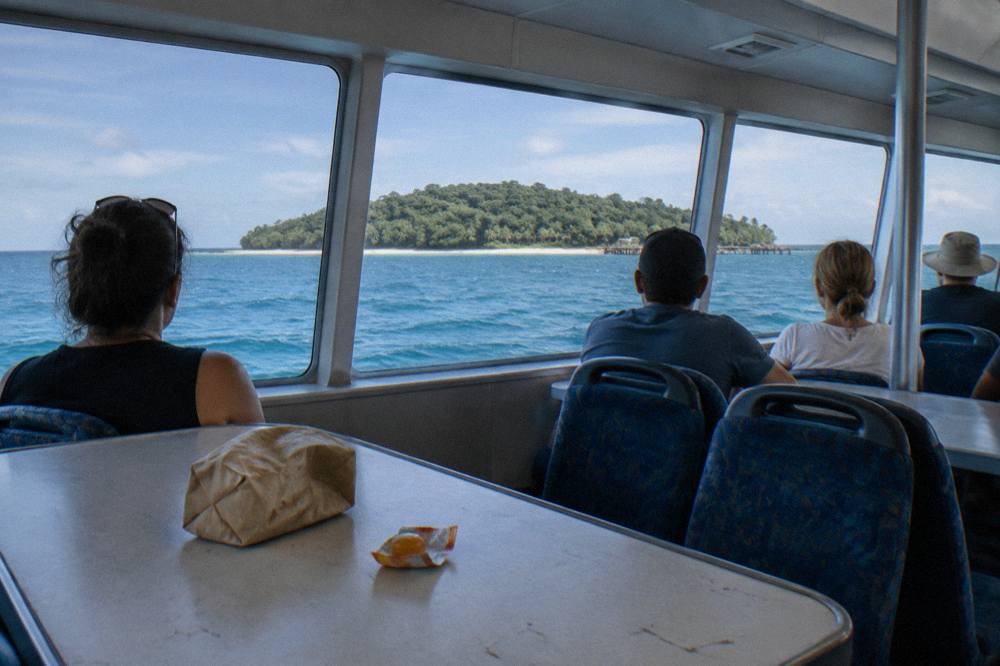
Sit as close to the middle of the boat as possible, on the lowest deck you can, facing forward, and stay where you can see the horizon: the centre of the vessel moves least in a seaway, while the bow pounds and the stern swings. On the Great Adventures and Big Cat catamarans that means the main cabin rather than the open top deck, and it means claiming a window seat early so your eyes have a steady external reference.
The mechanics are simple. Motion sickness happens when your inner ear feels movement your eyes cannot confirm, so the fix is to give your eyes the same information your body is getting. Looking at the horizon works because it is the one thing in the scene that stays put while the boat moves under you. Reading a phone, staring at a table, or facing backwards into the cabin does the opposite: your eyes report stillness while your inner ear reports the sea, and the mismatch is what makes people ill.
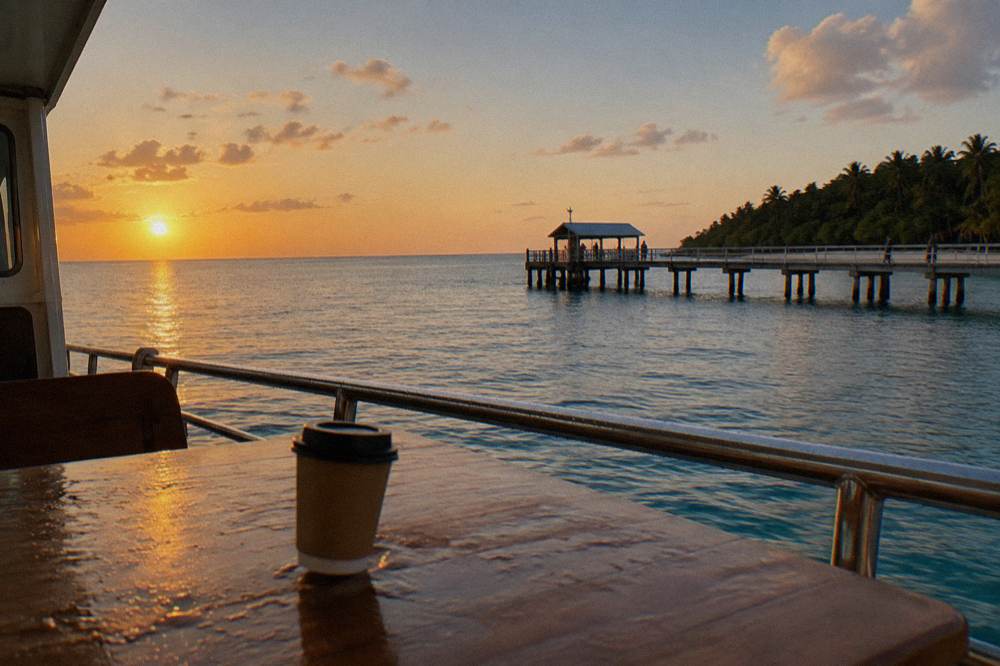
Boarding order matters for this. Great Adventures asks passengers to board 30 minutes before departure, and on a busy morning the window seats in the mid cabin go quickly. Check in early, walk the cabin once, and take the seat you want before the queue fills the aisles. On the Big Cat half days, the listing notes a snorkelling demonstration on the morning sailing, which is worth watching but worth watching facing forward with the horizon in your peripheral vision, not with your head down.
Two more habits that cost nothing: get fresh air rather than the warmest corner of the cabin, and keep your head still against the seat rest rather than bobbing around looking for the crew. If the crew offers commentary, listen with your eyes up and out. The 45 minutes pass quickly, and once you are inside the shelter of the island's reef the water flattens noticeably for the final approach to the jetty.
What Should You Eat And Drink Before A Green Island Cruise?
Eat a light, plain meal one to two hours before boarding, drink water steadily through the preceding hours rather than a large volume at once, and go easy on alcohol the night before and on greasy food the morning of. Do not sail on a completely empty stomach: an empty gut is as nausea friendly as an overfull one. Morning tea and coffee are served on the Great Adventures departures, which helps some stomachs.
The pattern that experienced boat crews describe is unglamorous: toast or plain cereal, some water, no big fry up, and nothing you would not want to think about again mid crossing. Both major operators make the eating question easier rather than harder. The Great Adventures listing includes morning tea and coffee on board, and the island itself has a lunch combo at Emeralds Restaurant plus the Canopy Grill and the Lite Bites Cafe through the middle of the day, so nobody needs to arrive heavy. Big Cat's listings treat lunch as an option you select rather than a base fare inclusion, and its half day listings state food and drinks are available to purchase.
Sleep and the night before belong in the same conversation. A short, broken night is one of the most reliable precursors to a bad crossing, and the early check in times on this route, boarding from 8:00am for the 8:30am Great Adventures departure, punish the late night. If you are staying in Cairns for the trip, the practical move is a hotel within a short walk or drive of the terminal at 1 Spence Street; the airport is roughly 10 to 15 minutes away by road, which makes a same morning arrival feasible in theory but risky in practice, and a rushed arrival is a poor final hour before a boat.
This article will not tell you what to take medicinally, because that depends on your health history and a website should not guess. What can be said is procedural: whatever remedy you and a pharmacist agree on, take it in the timeframe it specifies, which is usually before boarding, not once you already feel wrong. By the time the boat is pitching it is generally too late for anything you swallowed to catch up.
Does The Season Or The Weather Change The Crossing?
Yes, materially. The dry season months of roughly June to October bring the steadiest conditions in Cairns: Bureau of Meteorology averages show July and August as the driest and mildest months, while the summer months of January to March each average well over 400 mm of rain. The official cyclone season runs 1 November to 30 April, and stinger season, when suits are advised, runs November to June, though stingers are possible in any month.
The Cairns climate record tells the story plainly. Summer months average January maxima of 31.5 degrees and monthly rainfall figures in the range of 404.8 to 437.5 mm across January, February and March; the winter dry brings July maxima of 25.9 degrees with a July average of just 33.2 mm. None of that predicts any single day, and a flat calm February morning is entirely possible, but the statistics lean the way common sense suggests: dry season mornings are your best odds for a mirror smooth crossing, and the wet season raises both the chance of wind and the chance that an operator reschedules or cancels, which every listing here permits through its free cancellation policy.
One seasonal note that belongs to stingers rather than swell: Cairns Regional Council flags marine stingers as of particular concern from November to June and advises stinger suits in that window, while Queensland Parks notes stingers may be present in coastal waters at any time of year. That affects what you wear in the water, not how the boat behaves, but nervous travellers often bundle every tropical hazard into one anxiety, and it helps to separate them. The swim safety question and the motion question are different questions.
If you want the deeper background on picking your window, the site's own Green Island weather and timing guide breaks the calendar down month by month, and the stinger season explainer covers suits and seasons properly. For this article the short version stands: book early morning, book dry season if your dates allow, and watch the forecast two days out rather than two weeks.
Are Half Day Cruises Better For Nervous Sailors?
Yes, usually. A Big Cat half day runs about four hours with roughly 45 minutes of sailing each way, versus the eight hour full day, so a sensitive stomach spends half as long on open water for the same catamaran stability. The trade is island time: a half day gives you a couple of hours ashore rather than up to seven, which suits a look around, a snorkel and a walk, not a slow island day.
The half day options compared here are all run by Big Cat, and the boat time each involves is worth laying out side by side.
| Option | Duration | Water exposure | Island time | Rating and reviews | From price |
|---|---|---|---|---|---|
| Big Cat morning half day | 4 hours | Two crossings of about 45 minutes | Around 2 hours | 4.1 from 469 reviews | A$110 pp |
| Big Cat afternoon half day | 4 hours | Two crossings of about 45 minutes | Around 2 hours | 4.3 from 473 reviews | A$110 pp |
| Big Cat later start full day | 6 hours | Two crossings of about 45 minutes | Around 4 hours, from 11am | 4.3 from 273 reviews | A$110 pp |
| Great Adventures half day | 6 hours | Two crossings of about 45 minutes | Up to about 4 hours | 4.1 from 335 reviews | A$127 pp |
The morning half day includes the catamaran crossing, a snorkelling demonstration and your choice of snorkel gear hire or the glass bottom boat. The afternoon half day mirrors it after lunch. There is also the later start full day, which begins at 11am and runs six hours: same stability as the standard full day, but it lets the morning's calmest water go and hands you the steadier midday window instead of the sea breeze hours.
For a nervous sailor, the honest ranking is: a morning half day on the catamaran, then a morning full day, then an afternoon half day, then the later start, then the schooner, then the combos. The half day morning cruise sits second from the top on pure exposure maths, four hours door to door with two crossings you already know are short.
There is also a middle path worth knowing about on the Great Adventures side. Its half day product is a six hour day rather than Big Cat's four, which sounds worse for exposure but is not: the crossing legs are the same length on both operators, and the extra hours are spent on the island, not on the water. Time ashore is time your stomach does not care about. The real difference between a four hour and a six hour "half day" is what you can do on the island, which the site's half day tour guide covers in detail.
What Should You Do The Moment You Feel Queasy On Board?
Move to the middle of the boat if you are not there already, face forward, fix your eyes on the horizon or the shoreline, get fresh air on your face, keep your head still against a rest, and breathe slowly and evenly. Tell a crew member: they have seen it a thousand times, they can reseat you, and on the worst days they know where the boat moves least. Do not go below decks and do not read anything.
The crew point is not a courtesy line. On every one of the Green Island tours compared here the crew run the safety briefings, the snorkelling demonstrations and, on the Ocean Free sailings, in-water assistance, and re-seating a green passenger is among the most routine things they do. Saying nothing and suffering quietly in a stern cabin is the single worst strategy available, and it is also the most common one.
Two things help psychologically on this specific route. First, the crossing really is short, and once the island's reef shadow flattens the water for the jetty approach, most mild nausea eases within minutes of the engines slowing. Second, nearly everything that makes people ill is chosen before boarding: the boat, the seat, the breakfast, the night before. Fix those four and you have removed most of the risk without swallowing anything, which is the whole philosophy of this guide. As Great Adventures' own tour page confirms, the sailing itself is the 45 minute bookend on either side of the day, not the day.
For anyone weighing this island against its neighbour, the Green Island versus Fitzroy Island comparison notes that both islands sit about 45 minutes from Cairns, so the crossing exposure is close to identical and the boat, not the destination, is what you should choose on. This site, Green Island Great Barrier Reef Tours, carries the full compared listing set if you want to work through every option.
If your stomach is the deciding factor, these three are the picks worth checking availability on: the steadiest big catamaran, the cheaper twin hull alternative, and the sailing day for the water confident.
Common Questions About Avoiding Seasickness On A Green Island Cruise
How Do You Avoid Seasickness On A Green Island Cruise?
Choose a fast catamaran, sit mid-boat on a lower deck facing forward with the horizon in view, eat a light plain meal one to two hours before departure, get a proper night's sleep, and take the earliest morning departure, which usually catches the calmest water. The crossing itself is only about 45 minutes each way.
How rough is the crossing from Cairns to Green Island?
It varies. On a calm dry season morning the water is often near flat, and both operators' catamarans handle it comfortably. When wind runs against the tide it can be choppy, and in the approach to a tropical system operators may reschedule. The cyclone season window runs from 1 November to 30 April.
Is the catamaran or the schooner better if you get seasick?
The catamaran. The Great Adventures catamaran and the Big Cat vessels are wide twin hulled boats with a flat, quick motion, while the Ocean Free schooner is a smaller sailing vessel that heels and rolls more in the same conditions. The schooner is the better day for confident sailors, not for sensitive stomachs.
Should you eat before a reef cruise?
Yes, lightly. A plain meal an hour or two before boarding beats both a heavy fried breakfast and an empty stomach. Drink water steadily rather than all at once, and keep the night before free of excess alcohol. Morning tea and coffee are served on the Great Adventures departures.
Do half day Green Island cruises reduce seasickness risk?
They reduce exposure. A Big Cat half day runs about four hours with the same two short crossings as the full day, so you spend less time on open water for identical catamaran stability, at the same from price of A$110 per person.
What do you do if you feel sick on the boat?
Move to the middle of the vessel, face forward, look at the horizon, get fresh air, keep your head still and breathe slowly. Tell a crew member so they can reseat you. Avoid going below decks or reading. Most mild nausea eases as the boat slows for the island's sheltered jetty approach.